Tuesday, April 27, 2010

Today, the word Gothic primarily describes a style of European architecture which flourished from the twelfth through the sixteenth centuries, though the word seems originally to have referred to any non-classical (Greek or Roman) architecture. Gothic architecture used pointed arches and vaults, flying buttresses, narrow spires, stained glass windows, intricate traceries, and varied details; its upward movement was meant to suggest heavenward aspiration. One would think the opposite because of it gloomy, depressing meaning. When a person thinks 'gothic', they don't ever really think about heaven and God.

"The Gothic creates feelings of gloom, mystery, and suspense and tends to the dramatic and the sensational, like incest, diabolism, and nameless terrors. Most of us immediately recognize the Gothic (even if we don't know the name) when we encounter it in novels, poetry, plays, movies, and TV series. "

http://academic.brooklyn.cuny.edu/english/melani/gothic/gothic.html

--Tanya Rios

According to virtualsalt.com/gothic.htm, gothic novels have few specific elements in which they believe should be included for a novel to be considered 'gothic'. Some of these elements include:
1. Setting in a castle.
2. An atmosohere of mystery and suspense.
3. An ancient prophechy.
4. Omens, portents, visions.
5. Supernatural or otherwise inexplicable events.
6. High, even overwrought emotion.
7. Woman in distress.
8. Women threatened by a powerful, impulsive, tyrannical man.
9. The metonomy of gloom and horror.
10. The vocabulary of the gothic.

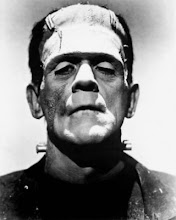
Frankenstein had half, if not most of these elements. The atmosphere was full of mystery and suspense because you never knew who might die next or where the creature may be. Victor Frankenstein considered his mothers death to be an 'omen' for future unfortunate events. This creature living among the living woulkd be considered 'supernatural'. Elizabeth was killed by the big creature. And in general the story is full of gloom and horror.

--Tanya Rios

Monday, April 26, 2010

Psycho Trailer

I posted this video from Alfred Hitchock because this black and white film relates to Mary Shelley's Gothic setting in many ways,the spooky setting of the trailer,the house in the hill, the horror and suspense of this movie make this type of old fashion serial killer a great combination of what many artist are influence by.

Writers who made Gothic Style popular

A Brief Historical Overview: "The first great practitioner of the Gothic novel, as well the most popular and best paid novelist of the eighteenth century England, was Ann Radcliffe. She added suspense, painted evocative landscapes and moods or atmsophere, portrayed increasingly complex, fascinatingly-horrifying, evil villains, and focused on the heroine and her struggle with him. Her best works–A Sicilian Romance (1790), The Mysteries of Udolpho (1794), and The Italian (1797), with the irredeemably malevolent monk, Schedoni–still have the ability to thrill and enthrall readers.
Inspired by Radcliffe and influenced by German sensationalist horror tales, Matthew Lewis wrote The Monk (1796). The novel follows the lust-driven monk Ambrosio from one abominal act to another–rape, incest, matricide, burial alive– to his gory death and well-deserved damnation. Naturally it was enormously successful and controversial. The story goes that Radcliffe, a sedate, conventional matron, was appalled at his novel and his acknowledging her influence on him, so she responded with The Italian, whose villain is also a monk, to show how a novel of terror and suspense should be written."
Women were a big influence in the beginning of the Gothic era as they inspired many writers to define the aspects of this trend.
www.ask.com/web?q=Modern+Gothic+Writing&qsrc=2991
Frankenstein by Mary Shelley and Wuthering Heights by Emily Bronte are very similar and both revolve around death. Death is used as a prominent element in both books, and both Shelley and Bronte use death to show the psychological changes within characters. Both books show the psychological changes between the main characters, and the ones living after the deaths have occurred. Although the books have similiar elements, they use them a bit differently. While Frankenstein takes a more violent look on life, Wuthering Heights deals with more of natural, psychological point of view.

--Tanya Rios

Tuesday, March 30, 2010

Tim Burton's Art Style

Tim Burton’s Goth Art Wows Crowds at MoMA
Tim Burton. (American, b. 1958) Untitled (Edward Scissorhands). 1990. Pen and ink, and pencil on paper, 14 1/4 x 9" (36.2 x 22.9 cm). Private Collection. Edward Scissorhands © Twentieth Century Fox © 2009 Tim Burton

The Museum of Modern Art has blown the lid off Tim Burton’s best-kept secret: he isn’t just an imaginative filmmaker; he’s also an amazingly talented artist. Burton’s retrospective, which is spread throughout the museum, focuses on the director’s 14 feature films, while also offering drawings, paintings, photographs, sketchbooks, props, and short films that have never previously been exhibited. Spanning a lifetime of creativity — from his teenage drawings and college films to character sketches from his upcoming Alice in Wonderlandmovie — Burton’s Gothic vision is as captivating as it is astounding.

Hundreds of magical works are exhibited salon-style in MoMA’s third-floor special-exhibitions gallery, which is entered by way of a three-dimensional monster’s mouth. The creature’s red-carpet tongue takes visitors down a black-and-white striped hallway, which displays flat-screen monitors playing Burton’s six-episode Internet series The World of Stainboy. Passing through this metaphorical orifice, you come out in a darkened gallery, filled with Day-Glo paintings of freaky characters on velvet and a rotating carrousel sculpture illuminated by black lights. Beyond this trippy room, nearly 40 years of Burton’s surreal style of thinking unfolds.

I am a loyal fan of Tim Burton's work.His Art is mysterious,dark, unpredictable and for me amazingly beautiful.In many movies like:Sleepy Hollow(1999),Edward Scissorhands(1990) ,The Nightmare Before Christmas(1993), Beettlejuice(1988) etc... We can see the Gothic influence that has captured many around the world.

httpflavorwire.com/57107/tim-burtons-goth-art-wows-crowds-at-momaa

Tim Burton’s Goth Art Wows Crowds at MoMA
Tim Burton. (American, b. 1958) Tim Burton's The Nightmare Before Christmas storyboard. 1993. Pen and ink, marker, and colored pencil on paper, 5 x 7" (12.7 x 17.8 cm). Private Collection. © 2009 Tim Burton.

Subcultural style

The goth subculture is a contemporary subculture found in many countries. It began in the United Kingdom during the early 1980s in the gothic rock scene, an offshoot of the Post-punk genre. The goth subculture has survived much longer than others of the same era, and has continued to diversify. Its imagery and cultural proclivities indicate influences from nineteenth century Gothic literature along with horror films and to a lesser extent the BDSMculture.[1][2][3]


The goth subculture has associated tastes in music, aesthetics, and fashion, whether or not all individuals who share those tastes are in fact members of the goth subculture. Gothic music encompasses a number of different styles. Styles of dress within the subculture range from deathrock, punk, androgynous, Victorian, someRenaissance and Medieval style attire, or combinations of the above, most often with black attire, makeup and hair.

This style represents freedom and uniqueness.not because someone is different from us means that you are evil or ugly(Just like we have read in Frankenstein)We all have to accept each other just the way we are and learn the importance of respect.
http://en.wikipedia.org/wiki/Goth_subculture

Monday, March 29, 2010


Gothic has become extremely popular in contemporary society. It has inspired many new works in film, literature, and of course music such as Marilyn Manson and bands like H.I.M. Surprisingly enough, it's also become pupolar in the fashion world. If you go to different parts of the city, or even just a mall, you'll see kids in what is now the "goth look". But there's also an increase in the couture goth fashion, such as the work of Alexander McQueen.

Catherine Cooper wrote a book about contemporary Goth, and she goes on to say "In an engaging way, Contemporary Gothic argues that this style ultimately balances a number of contradictions—the grotesque and incorporeal, authentic self-expression and campiness, mass popularity and cult appeal, comfort and outrage—and these contradictions make the Gothic a crucial expression of contemporary cultural currents. Whether seeking to understand the stories behind the TV show Supernatural or to extract deeper meanings from modern literature, Contemporary Gothic is a lively and virtually unparalleled study of the modern Gothic sensibility that pervades popular culture today. "

http://www.press.uchicago.edu/presssite/metadata.epl?mode=synopsis&bookkey=211261

--Tanya Rios
(1st Blog Assignment)

According to Dictionary.com, Gothic is defined as "noting or pertaining to a style of literature characterized by a gloomy setting, grotesque, mysterious, or violent events, and an atmosphere of degeneration and decay: 19th century gothic novels." In the story of "Frankstein", we read about the death of Victors mother. He calls her death "an omen of his future misery." Her death leads to his obsession with creating life.

--Tanya Rios

Wednesday, March 24, 2010

Walpole, Horace (1717- 1797)

English novelist, biographer, memoirist, historian, essayist, playwright, and letter writer.

of the most flamboyant personalities in eighteenth-century English letters, Walpole is often considered the outstanding chronicler and correspondent of his era. According to biographer W. S. Lewis (see Further Reading), "Walpole is the man who brought the art of letterwriting to the highest point it reached in our language." The Letters, which date from 1732 to 1797 and number in the thousands, are noted for their remarkable content as well as their distinctive style. While the detailed description they provide of English politics and society in Walpole's time is unsurpassed, they also possess stylistic charm and wit which make them highly entertaining prose. In addition to this achievement, Walpole is widely recognized as one of England's first art historians, an influential revivalist of Gothic architecture, and the author of The Castle of Otranto (1764), a work which pioneered the introduction of supernaturalism and mystery into the romance and is thus regarded as the first Gothic style.

This beautiful picture is a Strawberry Hill, an English villa in the "Gothic revival" style,build by seminal Gothic writer Horace Walpole.

It is so amazing to see so much talented artist at that time period, which gave a different touch to Gothic Art and also to the way people were used to see the world.

http://www.enotes.com/gothic-literature/walpole-horace

Gothic Art

Simone Martini, also known as Simone Memmi or Martino, was born in Siena in 1283 and died in 1349. He was a pupil of Duccio whom he eventually surpassed in terms of decorative quality and the Gothic Art style. The earliest of Martini's works include his fresco in Siena depicting the enthroned Virgin and Child. It was origianally painted in 1315, and then restored by Martini himself in 1321. In 1320 Simone Martini painted an altar pieced for St. Catherine's church at Pisa, and in 1321 he painted another altar piece for the church of San Dominico in Orvieto. In 1328 Simone painted a skillful portrait of Fogliano in honour of the capture of Montemassi, and went on to paint a series of works adorning the chapel of St. Martin. He also decorated rooms in the papal palace, and created the painting Madonna and Laura which is one of his most famous works.
I was amazed by his beautiful work that has so much life,i felt that I could almost touch it and also felt the pain that the characters were feeling at the time.
http://www.arthistoryguide.com/travel/travel26.aspx
Gothic is a huge theme in this book. I see death having a lot to do with the Gothic theme and this book basically revolves around the cycle of death. Victor Frankensteins mother died, creating what Victor considered an "omen". His passion of creating life out of death became an obsession and after a long time reading and talking to professors, he created an 8 foot tall creature whom he despises right off the bat and does everything in his power to stay away from. Because of the creatures isolation from the world and hatred from everyone, he learns to hate as well, and seeks revenge on his creator. Frankenstein kills Victors brother, and because of this, Justine is killed as well because Frankenstein framed her, and she was accused of the murder.

--Tanya Rios